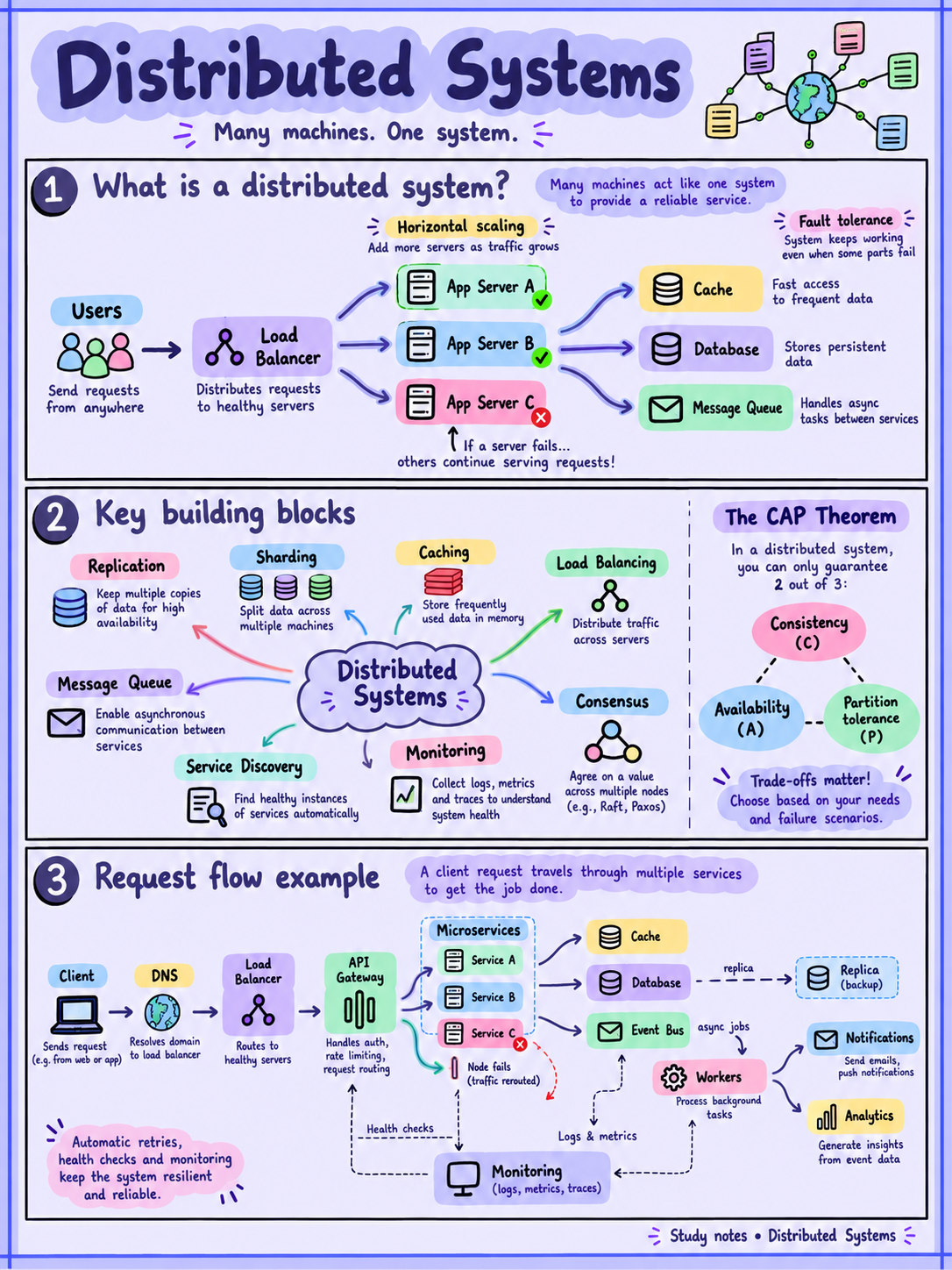
Distributed Systems: Many Machines, One System
Modern applications rarely run on a single machine. A popular website, banking platform, streaming service, or e-commerce application may serve millions of requests every day. Relying on one server would quickly become a bottleneck—and if that server failed, the entire service could disappear. This is where distributed systems come in.
A distributed system is a collection of independent computers that work together and appear to users as a single system. Instead of asking one machine to handle everything, the workload is shared across multiple servers, databases, caches, queues, and background workers.
The basic idea sounds simple:
Many machines. One system.
In practice, however, making all of those machines cooperate reliably is one of the most interesting challenges in software engineering.
What Is a Distributed System?
Imagine an application running on a single server.
Every user request goes to that machine. It runs the application logic, talks to the database, and returns a response.
This architecture can work perfectly well for a small application.
But what happens when traffic increases?
A single server has limited CPU, memory, network bandwidth, and storage. At some point, simply upgrading the machine becomes expensive or impossible.
Instead, we can add more servers.
The load balancer distributes requests between the available servers.
Now the system can process more requests at the same time.
This approach is called horizontal scaling: instead of making one machine more powerful, we add more machines.
There is another advantage.
If Server C crashes, Servers A and B can continue serving traffic.
That gives us one of the most important properties of distributed systems: fault tolerance.
Why Distributed Systems Matter
Distributed systems usually appear when applications need to solve three major problems: scale, reliability, and performance.
Scalability
Traffic is rarely constant.
An application might have 1,000 users today and 1,000,000 users next year.
Instead of redesigning the entire application, distributed architectures allow engineers to add more servers when demand increases.
For example:
Infrastructure can grow with the product.
Reliability
Hardware fails.
Servers crash. Networks disconnect. Disks fail. Data centers can even become unavailable.
A distributed system assumes failure will happen and designs around it.
Instead of depending on one database, for example, the system may keep several copies of the data.
If one copy becomes unavailable, another may continue serving requests.
Performance
Distributed systems can also place data and computation closer to users.
Frequently accessed data can be stored in caches, while expensive background work can run asynchronously.
The result is often faster response times and better resource utilization.
The Core Building Blocks
Most distributed architectures are combinations of a few fundamental ideas.
Load Balancing
A load balancer decides which server should receive each incoming request.
Instead of sending everything to one machine:
The load balancer may also perform health checks.
If Server C stops responding, traffic can automatically be redirected to Servers A and B.
Replication
Replication means storing multiple copies of the same data.
For example:
Replication improves availability and can sometimes improve read performance.
However, it creates a difficult question:
How do we keep all copies synchronized?
That question leads to one of the central challenges of distributed computing: consistency.
Sharding
Replication copies data.
Sharding splits data.
Suppose a database contains hundreds of millions of users. Instead of storing all users on one database server, the system might divide them across several machines.
The challenge becomes deciding which shard contains a particular piece of data and what happens when shards become unevenly loaded.
Caching
Some data is requested repeatedly.
Instead of querying the database every time, applications can store frequently used information in memory.
Caches can dramatically reduce database load and improve latency.
But caching introduces another classic distributed-systems problem:
What happens when cached data becomes outdated?
Cache invalidation sounds simple until multiple machines are involved.
Message Queues
Not every task needs to happen immediately.
Imagine a user places an order.
The application may need to send an email, generate analytics events, update inventory, and notify another service.
Making the user wait for all of those operations would be unnecessary.
Instead:
The application publishes a message, and background workers process it asynchronously.
This pattern makes systems more responsive and allows services to operate independently.
Service Discovery
In dynamic infrastructure, servers constantly appear and disappear.
A service may have ten instances now and twenty instances five minutes later.
Other services therefore need a way to answer:
Where is Service A currently running?
Service discovery keeps track of available service instances and allows applications to find healthy servers automatically.
Monitoring and Observability
Distributed systems are difficult to debug because a single request may travel through many services.
For example:
If the request takes five seconds, which component caused the delay?
This is why distributed systems rely heavily on logs, metrics, and traces.
Logs tell us what happened.
Metrics tell us how the system is behaving.
Distributed traces show how one request traveled across multiple services.
Without good observability, debugging a large distributed system can feel like investigating a crime scene without witnesses.
Consensus: Getting Machines to Agree
One of the hardest problems in distributed computing is agreement.
Imagine several servers maintaining shared state.
What happens if Node C temporarily loses its network connection?
What happens if two nodes receive conflicting updates?
Distributed consensus algorithms help machines agree on a shared value even when some components fail.
Well-known examples include Raft and Paxos.
These ideas appear in distributed databases, configuration systems, leader election, and cluster management.
The CAP Theorem in Simple Terms
One concept that appears constantly when discussing distributed databases is the CAP theorem.
CAP describes three properties:
Consistency means every client sees the same latest data.
Availability means every request receives a response.
Partition tolerance means the system continues operating even when parts of the network cannot communicate.
The important part is what happens during a network partition.
Imagine two database nodes suddenly lose their connection to each other.
Should both continue accepting requests?
If they do, users might temporarily see inconsistent data.
Or should one side stop accepting some requests until communication returns?
That preserves stronger consistency, but reduces availability.
There is no universal answer.
Different systems make different trade-offs depending on what they are designed to do.
A banking ledger, social-media feed, shopping cart, and analytics platform may each choose differently.
Following a Request Through a Distributed System
Consider a user opening an application.
The request might travel through something like this:
DNS first resolves the application domain.
The load balancer chooses a healthy server.
The API gateway may handle authentication, rate limiting, and routing.
The request reaches the appropriate microservice.
That service might check a cache before querying the database.
It may then publish an event to a message queue or event bus.
Background workers process that event later—for example, sending an email or recording analytics.
Meanwhile, monitoring systems collect logs, metrics, and traces from the entire flow.
To the user, however, all of this complexity appears as a single application.
That abstraction is one of the defining characteristics of a distributed system.
Failure Is Normal
One of the biggest mindset shifts in distributed-system design is accepting that failure is not an exceptional event.
It is expected.
A server can crash.
A database replica can fall behind.
A network request can time out.
A message can be delivered twice.
A service can become temporarily unavailable.
Good distributed systems are therefore designed around mechanisms such as retries, timeouts, replication, health checks, circuit breakers, idempotency, monitoring, and automatic failover.
The goal is not to build infrastructure that never fails.
The goal is to build a system that continues working even when individual components fail.
The Real Challenge: Trade-offs
Distributed systems give us enormous power, but they also introduce complexity.
Adding more machines creates more network communication.
Replication introduces consistency challenges.
Caching introduces stale data.
Retries can accidentally duplicate operations.
Sharding complicates queries.
Microservices create more network boundaries.
More infrastructure also means more things to monitor and operate.
For that reason, distributed architecture should solve a real problem rather than simply make an application look sophisticated.
A single application and one database can often support surprisingly large workloads.
Distribution becomes valuable when requirements such as scale, geographic reach, reliability, or organizational complexity justify it.
Key Takeaways
- Distributed systems combine multiple independent machines into one logical system.
- Load balancing, replication, sharding, caching, queues, service discovery, consensus, and monitoring are common building blocks.
- Network failures and partial failures are expected, so resilience must be designed into the architecture.
- There is rarely a perfect architecture—distributed-system design is largely about choosing the right trade-offs for your requirements.
Once these fundamentals make sense, topics such as microservices, Kubernetes, Kafka, distributed databases, event-driven architecture, Redis, database replication, and cloud-native systems become much easier to understand.
At its core, distributed systems engineering is really about answering one question:
How do we make many unreliable machines work together like one reliable system?