MCP vs API – What’s the Difference?
Large language models (LLMs) are powerful, but they don’t operate in isolation. To be truly useful, they need to interact with external data, services, and tools — whether that means fetching real-time information, executing commands, or integrating with existing software. For years, the standard way to connect software systems was through APIs (Application Programming Interfaces). But in late 2024, Anthropic introduced a new protocol specifically designed for AI: the Model Context Protocol (MCP).
At first glance, MCP and APIs seem similar — both allow one system to communicate with another. But the differences are significant, and they reveal a shift in how AI will interact with the world.
What MCP Does (And Why It’s Different)
1. A USB-C Port for AI
A good metaphor for MCP is USB-C. Just as USB-C provides a universal way to connect peripherals to a laptop, MCP provides a universal way to connect AI models to external services.
- MCP Host = The laptop (the AI system managing connections).
- MCP Clients = The ports (each handling a different external service).
- MCP Servers = The peripherals (databases, APIs, tools).
Unlike traditional APIs, where every integration is custom, MCP standardizes the interface. An AI agent can interact with any MCP-compatible service without needing prior knowledge of its specifics.
2. Two Core Problems MCP Solves
LLMs need two things from external systems:
- Context — Structured data (documents, database records, knowledge bases).
- Tools — Actions they can perform (search the web, send an email, run code).
MCP handles both through three primitives:
- Tools — Discrete functions an AI can call (e.g., get_weather, book_meeting).
- Resources — Read-only data (e.g., files, schemas, configs).
- Prompt Templates — Predefined instructions for common tasks.
A weather service, for example, might expose a get_weather tool, while a database server might offer query_records as a resource.
3. Dynamic Discovery
The biggest advantage of MCP is that AI agents can ask a server what it can do at runtime.
- An MCP client sends a request like tools/list to discover available functions.
- The server responds with descriptions, input/output formats, and usage examples.
- The AI can then invoke those tools without pre-programmed integration.
This is a major shift from REST APIs, where clients must be manually updated when endpoints change.
Press enter or click to view image in full size

How APIs Work (And Where They Fall Short for AI)
APIs have been the backbone of software integration for decades. A typical REST API:
- Uses HTTP methods (GET, POST, PUT, DELETE).
- Exposes endpoints like /books/123 or /users.
- Requires the client to know the exact request format in advance.
APIs are powerful, but they weren’t designed for AI. Problems include:
- No Discovery — An API doesn’t tell you what it can do; you have to read the docs.
- No Standardization — Every API has its own auth, error handling, and data formats.
- Static Integration — If the API changes, the client breaks until it’s updated.
MCP fixes these by making interactions self-describing and uniform.
Press enter or click to view image in full size

Key Differences Between MCP and APIs
Press enter or click to view image in full size

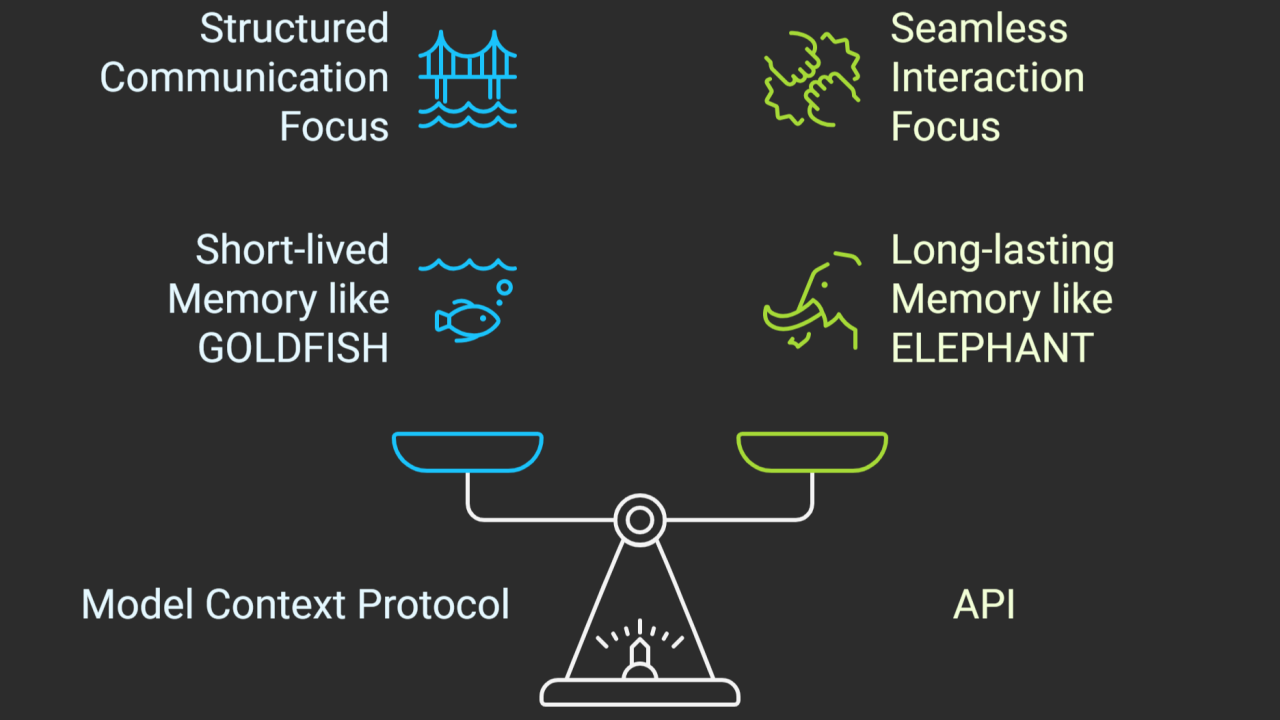
MCP and APIs serve similar purposes — connecting systems — but they differ in ways that matter for AI.
1. Purpose
APIs are general-purpose. They were designed for software-to-software communication, not specifically for AI. MCP, on the other hand, was built from the ground up for large language models. It standardizes how LLMs fetch context and use tools.
2. Discovery
With a traditional API, you need documentation. The API doesn’t tell you what it can do; you have to already know. MCP flips this. An MCP server can be queried — “What tools do you offer?” — and it responds with a machine-readable list of functions, their inputs, and their outputs. An AI agent can adapt to new capabilities without pre-programming.
3. Standardization
Every REST API is different. One might use OAuth for authentication, another API keys, another some custom scheme. One returns XML, another JSON. MCP eliminates this variability. All MCP servers speak the same protocol, so once an AI knows how to use one, it knows how to use any of them.
Get Tahir’s stories in your inbox
Join Medium for free to get updates from this writer.
Subscribe
4. Adaptability
If a REST API changes — a new endpoint, a modified response format — the client breaks until it’s updated. MCP avoids this because the client discovers capabilities at runtime. If a server adds a new tool, the AI can start using it immediately.
The Real Kick: MCP Wraps APIs
Many MCP servers are just translators for existing APIs. For example:
- An MCP GitHub Server might expose repository/list as a tool, but internally, it calls GitHub’s REST API.
- An MCP Database Server might offer query_table, but underneath, it uses SQL or a proprietary protocol.
This means MCP isn’t replacing APIs — it’s adding a layer on top, optimized for AI.
Why This Matters
- Easier AI Integration — Instead of writing custom code for every API, developers can build one MCP adapter and reuse it across AI systems.
- More Flexible Agents — LLMs can dynamically learn new capabilities without manual updates.
- Standardization — Just as USB-C replaced proprietary chargers, MCP could replace ad-hoc AI integrations.
Today, MCP already connects LLMs to services like Google Maps, Docker, Spotify, and enterprise databases. As AI becomes central to software, MCP is likely to become the default way models interact with the world.
The Bottom Line
- APIs are the old way — powerful, but not built for AI.
- MCP is the new standard — dynamic, self-describing, and AI-native.
The shift is happening because LLMs need a better way to discover and use tools. MCP provides that. It doesn’t eliminate APIs, but it does make them far more useful for AI.
And that’s a big deal.
Further Reading::
What is Detection as Code? How to implement Detection-as-Code
Stable Diffusion Deepfakes: Creation and Detection
🚨Oracle Cloud Data Breach: 6M Records Compromised
🚀DeepSeek R1 Explained: Chain of Thought, Reinforcement Learning, and Model Distillation
⚙️LangChain vs. LangGraph: A Comparative Analysis
🤖What is Manus AI?: The First General AI Agent Unveiled
🔗What is Model Context Protocol? (MCP) Architecture Overview
The Difference Between AI Assistants and AI Agents (And Why It Matters)
🤖DeepSeek R1 API Interaction with Python
Frequently Asked Question::
What is the main problem the Model Context Protocol (MCP) aims to solve for large language models (LLMs)?
MCP addresses the challenge of LLMs needing to interact with external data sources and tools to be truly useful. It standardises how applications provide context and enable tools for LLMs, particularly AI agents. Before MCP, this interaction typically relied on various application programming interfaces (APIs), which lacked standardisation and dynamic discovery capabilities.
How is MCP similar to and different from traditional Application Programming Interfaces (APIs)?
Both MCP and APIs use a client-server model and abstract away low-level implementation details, simplifying integration. However, their primary differences lie in purpose and dynamic discovery. MCP is specifically designed for LLM applications to standardise context provision and tool use, whereas APIs are general-purpose interfaces not tailored for AI. Crucially, MCP supports runtime discovery, allowing clients to query servers about their capabilities, while traditional REST APIs generally lack this dynamic feature.
Can you explain the core components of the MCP using the USB-C analogy provided in the source?
The source uses a USB-C analogy to explain MCP. In this analogy, the MCP host is like the laptop with USB-C ports, the MCP protocol is the standard USB-C connection itself, and the MCP servers are the various peripherals you can plug in, such as a monitor, external drive, or power supply. This highlights how MCP provides a standardised way for AI applications (the host) to connect and interact with different external services or data sources (the servers) using a common protocol.
What are the two main needs of LLM applications that MCP is designed to address?
MCP is designed to address two primary needs of LLM applications, especially AI agents: providing contextual data and enabling tools. Providing contextual data involves giving the LLM access to relevant information like documents, knowledge base entries, or database records. Enabling tools refers to allowing the LLM to execute actions or call external services, such as performing web searches, interacting with external services, or carrying out calculations.
What are the main primitives that MCP servers advertise to AI agents?
MCP servers can advertise several primitives to AI agents to indicate their capabilities. These include Tools, which are discrete actions or functions the AI can call (with descriptions of their name, purpose, inputs, and outputs); Resources, which are read-only data items that clients can retrieve (like text files or database schemas); and Prompt Templates, which are predefined suggestions for structuring prompts. While a server might not use all three, many focus on exposing Tools.
How does MCP facilitate dynamic discovery of capabilities for AI agents?
MCP enables dynamic discovery by allowing AI agents (clients) to query MCP servers at runtime. This means an AI agent can ask a server, “What can you do?” The server then responds by advertising its available primitives (tools, resources, etc.). This capability allows AI agents to adapt and utilise different server functionalities without requiring predefined knowledge of every possible interaction, making them more flexible and robust.
How does MCP relate to existing APIs, and are they competing technologies?
MCP and existing APIs are not competing technologies; they are complementary layers in the AI stack. Many MCP servers actually wrap existing APIs. This means an MCP server might expose a standardised MCP primitive (like accessing a repository list) while internally translating that MCP call into the native requests required by an underlying REST API (like GitHub’s API). MCP provides an AI-friendly interface on top of the underlying functionality provided by APIs.
How does the standardisation offered by MCP benefit AI applications and developers?
The standardisation provided by MCP offers significant benefits. For AI applications, it means they can interact with a wide variety of external data sources and tools using a single, consistent protocol, reducing complexity. For developers, it simplifies the process of integrating LLMs with external services, as they can rely on the MCP standard rather than having to learn the unique endpoints, parameters, and authentication methods of numerous individual APIs. This leads to faster development and easier maintenance.